
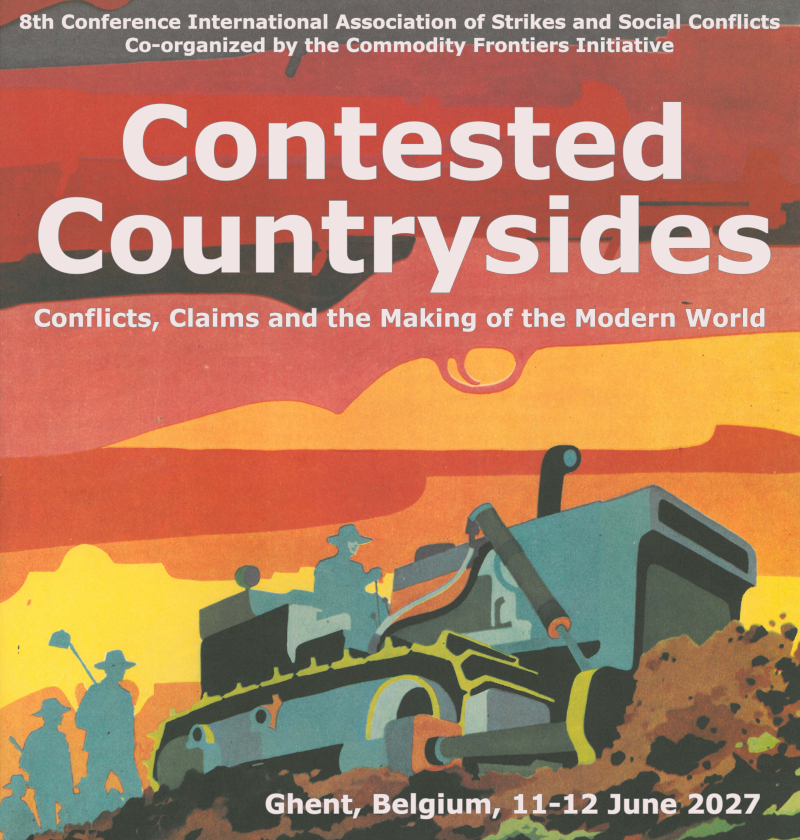
The 8th Conference of the International Association of Strikes and Social Conflicts, co-organized by the Commodity Frontiers Initiative and hosted by Amsab-Institute of Social History and Ghent University will be held on Friday 11 - Saturday 12 June 2027 in Ghent (Belgium) under the theme of Contested Countrysides: Conflicts, Claims and the Making of the Modern World.
Call for Papers
Throughout the last six centuries, worldwide capitalist expansion has been driven not in the least by advancing vast rural and agrarian frontiers of labour, food, energy, and raw materials. Up to now, capitalism has overcome problems of declining resilience of its production system by the progressive incorporation and appropriation of natural resources and labour through the successive opening of new, not yet fully commodified, zones. Our central argument is that capitalism as a historical system has been growing through the socio-ecological crises it encountered. In fact, crises are inherent and systemic to capitalism, as are movements of resistance and the counter-narratives that they generate.
Since the 1980s, a new wave of expansion and crises has accelerated the transformation of the global countryside. Agro-industrial production chains destroy local food markets, endangering the food supplies of households and communities, vulnerable to the vicissitudes of global food and agricultural markets. Dispossession in the global countryside and concentration of the governance of commodity chains in the hands of a limited number of powerful transnational corporations are two sides of the same coin.
In this conference we explore and discuss the dialectical relationship between dispossession and resistance along two interrelated lines.
First, we study countrysides as contested frontier zones in a comparative and long-term perspective. Frontiers are envisioned as historical and dynamic processes of both incorporation and differentiation, through which we can grasp the imbalances of incorporation processes, emphasising the role of the margins and friction zones and integrating nature and ecology as a defining part of the global economy.
Suggested themes:
- What are old and new forms of conflict and resistance, ranging from anti-slavery rebellions to modern peasant movements?
- How did workers’ resistance attain a transnational character?
- How do local and indigenous communities organise their struggles against the incursions of transnational capital into agrarian spaces and practices?
- How can movements of resistance protect knowledge and integrate new technological revolutions such as AI?
In a second line we investigate how the commodification of the rural world as an infinite set of localised but often interconnected processes was embedded in capitalist expansion and its political economy at large, and how this has affected forms of conflict and resistance. The increasing socialisation of production on a global scale – and its private appropriation – has contributed to bringing the countryside closer to the city, industrial work, services, and agricultural wage earners – but also to their interdependence in production chains and the contagious effect or example of their struggles (translatability). In these cases, “choking points” play a decisive role.
Moreover, at this conference, we attribute a special importance to the recent surge of Artificial Intelligence (AI). AI is not just another tool susceptible to being used for good or ill. Tools alter our symbolic structure, our brain, body, and social relationships. AI was deliberately designed to be an artifact that expropriates human beings from the most complex ideation. It engenders a subordination of real work, a maximum Taylorisation of creative, intellectual work, and potentiates alienation in work processes
Suggested themes:
- The impact/role on production on a global scale of transport systems (railroads, shipping), of critical nodes and chokepoints such as ports, and of spaces of manufacturing.
- The impact/role of networks of information and knowledge on production on a global scale.
- The rise of AI and its effects, such as the destruction of public funds transferred to large technology and data corporations ; the intensification of work ; the breakdown of relationships between human beings ; and the subordination of platforms and education systems structured by AI in the grammar of war, through drones, surveillance, and control systems.
However, in view of the entanglement of rural processes and the wider global context of progressing expropriation, we encourage speakers in this second line of broader themes to consider and integrate possible associations with the main theme of the conference.
Practical
The conference will take place in Ghent, Belgium, 11-12 June 2027. It is an in-person conference, no hybrid sessions available.
The conference is held by the International Association of Strikes and Social Conflicts (IASSC) and the Commodity Frontiers Initiative, and organised by Amsab-Institute of Social History, Ghent University – Conflict Research Group, Ghent University – Global and Regional Histories and Ghent University – Institutional, Socio-economic and Political Issues in Rural-urban Areas (INSPIRA).
The conference will involve a registration fee of 50 euro. Travel and accommodation are at your expense. For any questions, please contact the organizers.
Proposals should contain a short abstract and a short biographical note and must be submitted before 31 October 2026 by e-mail to
You will receive a note of acceptance before 1 December 2026. Registrations to the conference will open early 2027, upon further notice.
After the conference, the journals Workers of the World and Commodity Frontiers may invite participants to submit a proposal for a journal article.